

Cosmetics Regulatory Services: Complete Guide

Bringing a cosmetic product to market in India involves far more than a strong formulation and attractive packaging. Every brand — whether manufacturing domestically, importing finished goods, or operating a testing laboratory — must satisfy a layered set of legal requirements enforced by multiple authorities simultaneously. Trying to navigate this landscape without structured, specialist support is one of the most common reasons brands face delays, rejections, or unnecessary cost overruns. Cosmetics Regulatory Services exist precisely to solve this problem, giving brands the expertise, documentation support, and filing management needed to achieve compliance with confidence. Firms such as Regalliance have built their entire practice around delivering exactly this kind of support for both international and domestic cosmetics businesses operating in India.
What Cosmetics Regulatory Services Actually Cover
The term “cosmetics regulatory services” is broader than many brands initially assume. It is not simply about filing one form on a government portal — it covers every stage from initial product classification through post-approval maintenance years later. A genuine regulatory services provider evaluates whether a product legally qualifies as a cosmetic, determines the correct licensing or registration pathway, prepares a technically complete dossier, manages portal submissions, handles regulator queries, audits labels for compliance, and tracks renewal deadlines well after the first approval is granted. This end-to-end scope is what separates a true regulatory partner from a basic documentation agent, and it is the standard reflected in Regalliance’s cosmetic registration services.
The Regulatory Framework Behind These Services
India’s cosmetics sector is governed primarily by the Drugs and Cosmetics Act, 1940, and the Cosmetics Rules, 2020, which modernized the older framework and introduced dedicated forms, digital filing through CDSCO’s SUGAM portal, and updated Good Manufacturing Practice norms under Schedule M-II. The Central Drugs Standard Control Organisation handles import registration and national policy, while individual State Licensing Authorities oversee manufacturing, loan, and testing licenses at the local level. The Bureau of Indian Standards additionally enforces quality benchmarks for specific product categories. Official updates are published on the CDSCO and BIS portals, and a qualified regulatory services provider monitors these channels continuously so that client filings always reflect current requirements — a form of ongoing regulatory vigilance that Regalliance maintains as a standard part of every client relationship.
Import Registration Support (COS-1 and COS-2)
For overseas manufacturers, import registration is the gateway into the Indian market. The process requires an Authorized Indian Agent to file Form COS-1 through CDSCO’s SUGAM portal, supported by a full dossier including the Free Sale Certificate, Power of Attorney, GMP documentation, INCI-based formulation disclosure, Certificate of Analysis, safety data, and India-compliant labels. Once satisfied, CDSCO issues the Registration Certificate in Form COS-2, valid for five years and renewable before expiry. A regulatory services provider manages every element of this process — appointing or acting as the agent, calculating government fees correctly, and responding to CDSCO queries within required timeframes. Brands seeking this kind of support can explore the full scope of Regalliance’s cosmetic registration services or connect directly through regalliance.in.
Manufacturing, Loan, and Testing License Support (COS-3 to COS-8)
Cosmetic Manufacturing Licence in India
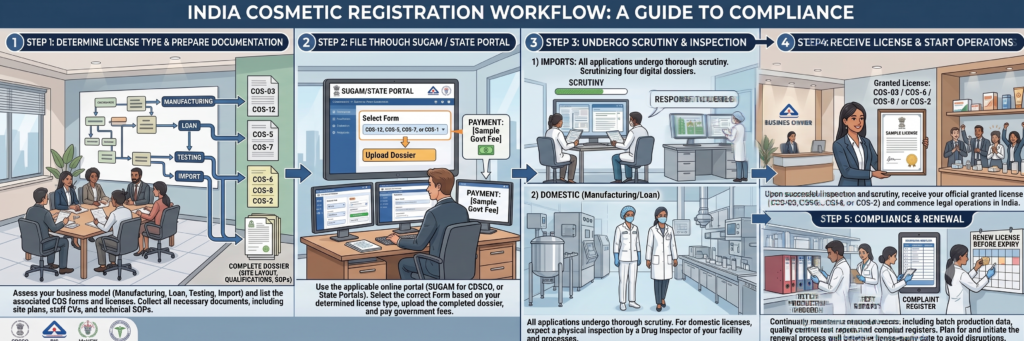
Domestic manufacturers intending to manufacture cosmetics for sale or distribution in India must obtain a manufacturing licence from the concerned State Licensing Authority under the Cosmetics Rules, 2020. The application for a regular manufacturing licence is submitted in Form COS-5. For a loan licence, the application is submitted in Form COS-6.
Applicants must provide the prescribed documents and submit a self-declaration in Form COS-7 confirming compliance with the applicable Good Manufacturing Practices and requirements relating to premises, plant and equipment specified in the Seventh Schedule of the Cosmetics Rules, 2020.
The State Licensing Authority scrutinises the application and supporting documents. Once the applicable requirements are fulfilled, the regular manufacturing licence is granted in Form COS-8, while a loan licence is granted in Form COS-9.
| Requirement | Form / Requirement | Regulatory Position |
|---|---|---|
| Regular Manufacturing Licence | Application: COS-5 | Granted by the State Licensing Authority in Form COS-8. |
| Loan Licence | Application: COS-6 | Permits manufacturing through an eligible licensed manufacturing facility, subject to the requirements of the Cosmetics Rules. The loan licence is granted in Form COS-9. |
| GMP & Premises Compliance | Self-declaration: COS-7 | Covers compliance with the applicable GMP and requirements for premises, plant and equipment specified in the Seventh Schedule. |
| Site Inspection / Verification | State Licensing Authority | The site is to be inspected and the information in Form COS-7 verified within 30 days from the date of grant of the licence or loan licence. |
Cosmetic Testing Laboratory Approval
Laboratories that carry out tests on cosmetics or raw materials used in their manufacture on behalf of cosmetic manufacturing licensees are regulated under Chapter VIII of the Cosmetics Rules, 2020. This approval is separate from a cosmetic manufacturing licence.
An eligible laboratory seeking approval to carry out such testing applies to the State Licensing Authority in Form COS-22. Where the applicable requirements are satisfied, approval for carrying out the specified tests is granted in Form COS-23.
The approval process covers matters such as suitable testing premises, ventilation and lighting, adequate space, testing equipment and competent technical personnel. Laboratories must also satisfy the applicable accreditation and regulatory requirements prescribed under the Cosmetics Rules.
| Testing Requirement | Form | Purpose |
|---|---|---|
| Application for Laboratory Approval | COS-22 | Application to the State Licensing Authority for approval to carry out specified tests on cosmetics or relevant raw materials on behalf of cosmetic manufacturing licensees. |
| Laboratory Approval | COS-23 | Approval for carrying out the specified testing activities on cosmetics and raw materials. |
Regulatory Support for Cosmetic Businesses
Regulatory support for cosmetic businesses can include determining the applicable licensing pathway, preparing the prescribed application and supporting documents, reviewing manufacturing premises and GMP readiness, assisting with Form COS-7 compliance, and preparing businesses for regulatory inspection and verification. For testing laboratories, support may include assessment of applicable requirements, documentation, testing infrastructure and preparation of the Form COS-22 application.
Label and Claims Compliance Auditing
Label non-compliance is one of the most frequent reasons for regulatory objections, making this a core part of any regulatory services engagement. Indian labels must carry the product name, manufacturer and importer details, net content, batch number, manufacturing and expiry dates, usage instructions, country of origin, and — for imported products — the COS-2 registration number. Colourants must be selected from the approved Schedule Q list, and no cosmetic label may carry therapeutic or medicinal claims, since doing so reclassifies the product as a drug and triggers a far more demanding regulatory pathway. India also enforces a strict ban on cosmetics tested on animals. A thorough label audit by Regalliance catches issues like these before submission rather than after costly print runs have already gone out.
Ongoing Compliance: Renewals and Post-Approval Changes
Regulatory work does not end once a certificate or license is issued. Import registration certificates must be renewed before their five-year expiry, manufacturing licenses face periodic state-level renewal and inspection, and any change to formulation, labeling, or manufacturing site must be formally reported to the relevant authority. Proactive renewal tracking and change management are standard components of a long-term regulatory services relationship, and this kind of ongoing support is a significant part of what Regalliance provides clients well beyond initial approval.
Common Problems These Services Prevent
- Misclassification of borderline cosmetic-drug products, leading to filings under the wrong pathway
- Incomplete or expired supporting documents causing straightforward rejections
- Therapeutic claims on labels that trigger unwanted drug reclassification
- Unapproved colourants or restricted ingredients discovered only after submission
- Missed CDSCO query deadlines that stall or abandon an application
- Underpaid government fees due to incorrect product, variant, or site counting
Why choose Regalliance?
Given the technical documentation and regulatory back-and-forth involved in registering cosmetics, most brands benefit from expert regulatory support. Regalliance assists businesses with product classification, dossier preparation, SUGAM portal filing, CDSCO query handling, label review, manufacturing licence support for domestic brands, and guidance on post-approval queries.
With end-to-end regulatory assistance, businesses can navigate the cosmetic registration process more efficiently while reducing documentation errors, regulatory delays, and unnecessary compliance challenges.
Comprehensive Cosmetic Regulatory Support
Regalliance supports brands throughout the cosmetic regulatory lifecycle, including product classification, technical dossier preparation, SUGAM portal submissions, CDSCO query responses, label compliance review, manufacturing licence support, and post-approval regulatory guidance.
Learn more about the team's experience and background on the About Regalliance page, or explore the complete range of Cosmetics Registration Services .
Conclusion
Whether you are a startup or an established global brand, completing Cosmetic Product Registration in India correctly helps protect your business legally and builds consumer trust in a fast-growing market. Getting the process right the first time can save months of delay and unnecessary costs while helping ensure a smoother regulatory journey.
Ready to Register Your Cosmetic Products?
Connect with Regalliance for expert regulatory guidance, documentation support, and complete cosmetic product registration solutions in India.
Contact RegalliancePhone: +91 9457775717
Email: info@regalliance.in