

Cosmetic Product Registration in India
India’s beauty and personal care industry is one of the fastest-growing consumer sectors in the world, and this rapid expansion has brought increasingly strict regulatory oversight. Before any cosmetic product reaches Indian shelves or e-commerce platforms — whether manufactured domestically or imported from abroad — it must successfully complete Cosmetic Product Registration in India, a mandatory legal process overseen by the Central Drugs Standard Control Organisation (CDSCO).
Skipping or mismanaging this requirement can lead to customs seizures, financial penalties, and lasting damage to your brand’s reputation. Many international and domestic brands work with an experienced regulatory partner such as Regalliance to avoid these pitfalls and move through the process efficiently, and you can explore their full range of offerings at regalliance.in before diving into the details below. This guide covers everything you need to know about registering cosmetics in India, including the legal framework, required documentation, timelines, fees, and how expert support can simplify the entire journey.
Legal Framework Governing Cosmetic Registration in India
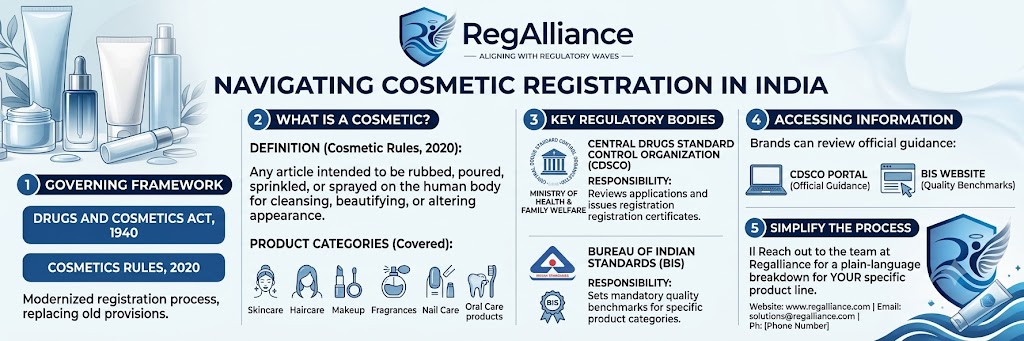
Cosmetic registration in India is governed by the Drugs and Cosmetics Act, 1940, along with the Cosmetics Rules, 2020, which replaced the older cosmetic-specific provisions of the 1945 Rules and modernized the registration process considerably. Under these regulations, a “cosmetic” is defined as any article intended to be rubbed, poured, sprinkled, or sprayed on the human body for cleansing, beautifying, or altering appearance — a definition covering skincare, haircare, makeup, fragrances, nail care, and several oral care products. The CDSCO, operating under the Ministry of Health and Family Welfare, is the central authority responsible for reviewing applications and issuing registration certificates, while the Bureau of Indian Standards sets mandatory quality benchmarks for specific product categories. Brands can review official guidance directly through the CDSCO portal and the BIS website, or simply reach out to the team at Regalliance for a plain-language breakdown of how these rules apply to a specific product line.
Who Needs Cosmetic Product Registration in India?
Registration requirements differ depending on whether a product is imported or manufactured domestically, and identifying your category early prevents filing errors later. Imported cosmetics require mandatory CDSCO registration before they can enter the Indian market. The overseas manufacturer must appoint an Authorized Indian Agent, importer, or subsidiary, who files the application in Form COS-1 through the CDSCO’s SUGAM online portal. Once approved, CDSCO issues a Registration Certificate in Form COS-2, generally valid for five years and renewable before expiry to continue legal operations. Domestically manufactured cosmetics, on the other hand, do not need this import-style registration certificate. Instead, local manufacturers must obtain a manufacturing license from their State Licensing Authority and comply with Good Manufacturing Practices under Schedule M-II of the Drugs and Cosmetics Rules. Businesses uncertain about which pathway applies to them, or whether a formulation qualifies as a cosmetic rather than a drug, often benefit from the dedicated cosmetic registration services offered by regulatory specialists who handle both imported and domestic categories end-to-end, and further details on this service can be found at regalliance.in/cosmetics-registration-services.
Documents Required for Registering Cosmetics in India
A smooth registration outcome depends heavily on documentation accuracy, since incomplete dossiers are among the leading causes of CDSCO delays and rejections. Typical requirements include:
- Power of Attorney authorizing the Indian agent
- Free Sale Certificate (FSC) from the country of origin
- Complete product formulation listing INCI-named ingredients and percentages
- GMP certificate and manufacturing site details
- Product labels compliant with Indian labeling rules
- Safety and toxicological data, along with an undertaking confirming the absence of banned substances
- Certificate of Analysis (CoA) for each product variant being registered
Preparing this dossier correctly the first time can save months of back-and-forth, which is exactly the kind of support offered through Regalliance’s cosmetic registration services.
Step-by-Step Registration Process
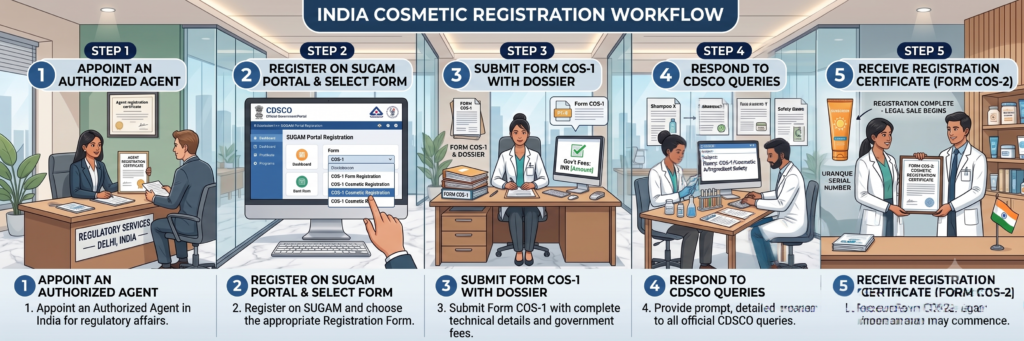
- Appoint an authorized agent in India to manage filings and CDSCO correspondence.
- Register on the SUGAM portal and select the appropriate registration form.
- Submit Form COS-1 with the complete dossier and applicable government fees.
- Respond promptly to CDSCO queries regarding ingredients, labels, or safety data.
- Receive the Registration Certificate (Form COS-2), after which legal import and sale can begin.
Brands that prefer expert handling of every one of these steps typically turn to a specialist team like Regalliance, which manages the process from SUGAM setup through certificate issuance.
Timelines, Fees, and Common Challenges
Most registration applications take three to six months, depending on document completeness and how quickly queries are resolved. Government fees vary according to the number of categories, variants, and manufacturing sites covered under the application. Common challenges include misclassifying a cosmetic as a drug, incomplete ingredient disclosures, non-compliant labels, expired Free Sale or GMP certificates submitted at the time of filing, and delayed responses to CDSCO queries — issues that a well-prepared dossier and experienced guidance from Regalliance can largely prevent.
Why choose Regalliance?
Given the technical documentation and regulatory back-and-forth involved in registering cosmetics, most brands benefit from expert regulatory support. Regalliance assists businesses with product classification, dossier preparation, SUGAM portal filing, CDSCO query handling, label review, manufacturing licence support for domestic brands, and guidance on post-approval queries.
With end-to-end regulatory assistance, businesses can navigate the cosmetic registration process more efficiently while reducing documentation errors, regulatory delays, and unnecessary compliance challenges.
Comprehensive Cosmetic Regulatory Support
Regalliance supports brands throughout the cosmetic regulatory lifecycle, including product classification, technical dossier preparation, SUGAM portal submissions, CDSCO query responses, label compliance review, manufacturing licence support, and post-approval regulatory guidance.
Learn more about the team's experience and background on the About Regalliance page, or explore the complete range of Cosmetics Registration Services .
Conclusion
Whether you are a startup or an established global brand, completing Cosmetic Product Registration in India correctly helps protect your business legally and builds consumer trust in a fast-growing market. Getting the process right the first time can save months of delay and unnecessary costs while helping ensure a smoother regulatory journey.
Ready to Register Your Cosmetic Products?
Connect with Regalliance for expert regulatory guidance, documentation support, and complete cosmetic product registration solutions in India.
Contact RegalliancePhone: +91 9457775717
Email: info@regalliance.in