

Drug Regulatory
Services
At Regalliance, our team brings a cumulative experience of many years in regulatory affairs. Over the years, our seasoned experts have provided exhaustive regulatory solutions, establishing clear pathways for the successful registration, manufacturing, and marketing permissions of drug products in India.
We navigate the complex statutory frameworks managed by the Central Drugs Standard Control Organization (CDSCO) and State Licensing Authorities (SLA) under the Drugs and Cosmetics Act, 1940 and Drugs and Cosmetics Rules, 1945, ensuring absolute compliance and zero-friction market entry for domestic and global pharmaceutical companies.

Drug Regulatory Services
At Regalliance, our team brings a cumulative experience of more than 50 years in regulatory affairs. Over the years, our seasoned experts have provided exhaustive regulatory solutions, establishing clear pathways for the successful registration, manufacturing, and marketing permissions of drug products in India.
We navigate the complex statutory frameworks managed by the Central Drugs Standard Control Organization (CDSCO) and State Licensing Authorities (SLA) under the Drugs and Cosmetics Act, 1940 and Drugs and Cosmetics Rules, 1945, ensuring absolute compliance and zero-friction market entry for domestic and global pharmaceutical companies.
Introduction
The import, manufacturing, sale, and distribution of pharmaceutical products in India are strictly regulated under Chapter III & IV of the Drugs and Cosmetics Act, 1940 and Part IV of the Drugs and Cosmetics Rules, 1945. Bulk drugs (Active Pharmaceutical Ingredients – APIs) and finished formulations fall within this purview.
Any substance categorized as a drug under Section 3(b) of the Act must be registered prior to commercial distribution or import, along with the physical manufacturing site where the product is produced.
Statutory Definition of a "Drug"
In accordance with Section 3(b) of the Drugs and Cosmetics Act, 1940, a Drug includes:
Medicinal Products: All medicines for internal or external use of human beings or animals.
Diagnostic & Therapeutic Substances: All substances intended to be used for or in the diagnosis, treatment, mitigation, or prevention of any disease or disorder in human beings or animals, including topically applied formulations intended to repel insects (e.g., mosquito repellents).
Substances Affecting Body Function & Pest Control: Substances (other than food) intended to affect the structure or any function of the human body or intended for the destruction of vermin or disease-causing insects, as notified by the Central Government in the Official Gazette.
Components & Inactive Inputs: All substances intended for use as components of a drug, including empty gelatin capsules.
Classification of Drugs
Indian regulations categorize pharmaceutical entities into specialized sub-classifications based on risk, therapeutic novelty, and clinical history:
Drug Classifications Under the NDCT Rules, 2019
A. New Drug
A product is classified as a New Drug if it meets one or more of the following statutory criteria:
- An Active Pharmaceutical Ingredient (API) or phytopharmaceutical drug not previously approved or used to any significant extent in India.
- An already approved drug proposed with new indications, dosage, route of administration, dosage form, or therapeutic claims.
- A Fixed-Dose Combination (FDC) introduced for the first time or an approved combination with a modified ingredient ratio.
- A Modified Release, Sustained Release, Controlled Release formulation or a Novel Drug Delivery System (NDDS).
- Biological products including vaccines, recombinant DNA (r-DNA) products, living modified organisms, monoclonal antibodies, stem cell-derived therapies, gene therapies, and xenografts.
B. Investigational New Drug (IND)
An Investigational New Drug (IND) refers to a new chemical or biological entity that has not been approved for marketing as a drug in any country worldwide. These products are generally intended for preclinical studies, clinical investigations, and regulatory evaluation prior to commercialization.
C. Subsequent New Drug (SND)
A Subsequent New Drug (SND) refers to an already approved New Drug that is proposed by a subsequent applicant with modified therapeutic claims, indications, dosage, dosage form, route of administration, or other approved variations requiring fresh regulatory review.
D. Orphan Drugs
An Orphan Drug is intended for the diagnosis, prevention, or treatment of a rare disease affecting not more than 5 lakh (500,000) persons in India. These products may receive special regulatory consideration to encourage the development of therapies for rare conditions.
Regulatory Requirements for Importer and Manufacturer
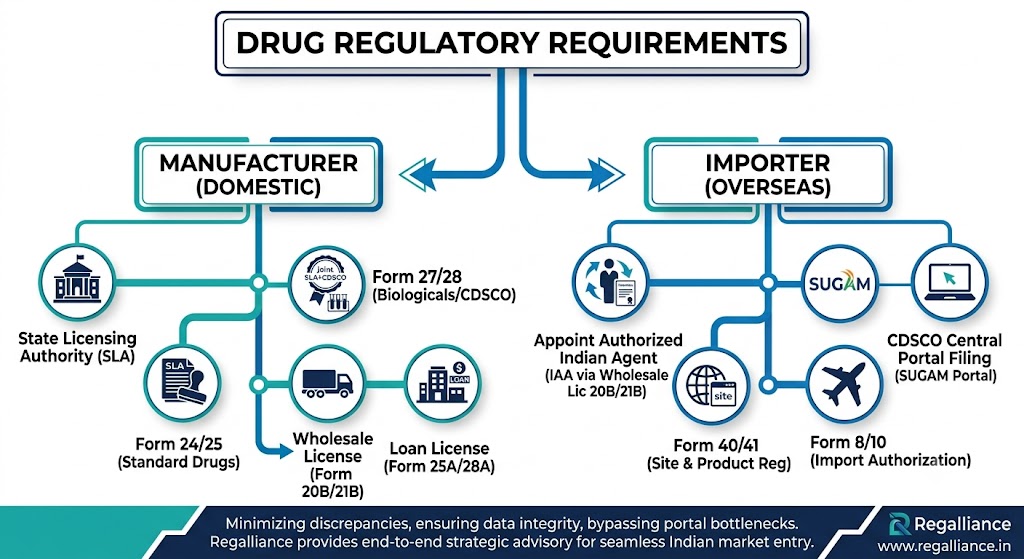
Manufacturing & Local Distribution Compliance
- Facility & Site Licensing: Manufacturing facilities must comply with Schedule M Good Manufacturing Practices (GMP) and obtain manufacturing licenses from the regional State Licensing Authority (SLA).
- Wholesale & Distribution Licenses: Stocking, selling, or wholesale distribution requires valid Form 20B (non-Schedule X drugs) and Form 21B (Schedule X drugs), with periodic renewal through Form 21C.
- Contract & Loan Licensing: Companies utilizing third-party manufacturing facilities must obtain Loan Licenses under Form 25A (standard drugs) or Form 28A (biologicals and specialized drugs).
Involved Regulatory Bodies
Primary authority responsible for manufacturing licenses, facility approvals, and wholesale distribution licensing.
Joint approval authority for biological products, vaccines, and New Drugs.
Required Forms & Overview
Manufacture of non-biological allopathic drugs.
Manufacture of biological products and Schedule C/C1 drugs.
Wholesale drug distribution licenses.
Authorized Indian Agent (IAA)
Overseas manufacturers cannot directly submit applications through Indian government portals. They must appoint an Authorized Indian Agent (IAA) holding valid Form 20B and Form 21B wholesale licenses to manage regulatory filings and assume statutory responsibility.
Involved Regulatory Body
Required Forms & Overview
Registration of foreign manufacturing sites and individual drug products.
Commercial import license for non-Schedule X drug formulations.
Commercial import license for Schedule X controlled substances.
Statutory Forms & Government Fees
Import, Registration & Clinical Infrastructure
| S. No. | Application Form | Official Approval / License Received | Regulatory Authority | Government Statutory Fees |
|---|---|---|---|---|
| 1 | Form 8 – Application for Licence to Import Drugs (Excluding Schedule X) | Form 10 – Licence to Import Drugs (Excluding Schedule X) | CDSCO | ₹10,000 for one product + ₹1,000 per additional product |
| 2 | Form 8A – Application for Licence to Import Drugs specified in Schedule X | Form 10A – Licence to Import Drugs specified in Schedule X | CDSCO | ₹10,000 for one product + ₹1,000 per additional product |
| 3 | Form 40 – Application to Import Drugs | Form 41 – Registration Certificate for Foreign Manufacturing Site & Drug Product | CDSCO |
US$10,000 (Manufacturing Plant) US$5,000 per Product |
| 4 | Form CT-01 – Application for Registration / Renewal of Ethics Committee |
Form CT-02 (Clinical Trial / BA-BE) Form CT-03 (Biomedical & Health Research) |
CDSCO | To be confirmed (Not specified under standard rules) |
| 5 | Form CT-04 – Application for Permission to Conduct Clinical Trial of a New Drug / IND | Form CT-06 – Permission to Conduct Clinical Trial | CDSCO |
Phase I – ₹3,00,000 Phase II, III & IV – ₹2,00,000 |
| 6 | Form CT-05 – Application for Permission to Conduct BA / BE Study | Form CT-07 – Permission to Conduct BA / BE Study | CDSCO | ₹2,00,000 |
| 7 | Form CT-08 – Application for Registration / Renewal of BA/BE Study Centre | Form CT-09 – Grant of Registration of BA/BE Study Centre | CDSCO | ₹5,00,000 |
Manufacturing, Import & Commercial Approvals
| S. No. | Application Form | Official Approval / License Received | Regulatory Authority | Government Statutory Fees |
|---|---|---|---|---|
| 8 | Form CT-10 – Application to Manufacture New Drug / IND for Clinical Trial, BA/BE Study, Test & Analysis | Form CT-11 – Permission to Manufacture New Drug / IND | CDSCO | ₹5,000 per Product |
| 9 | Form CT-12 – Application to Manufacture Formulation of Unapproved API | Form CT-15 – Permission to Manufacture Unapproved API | CDSCO | ₹5,000 per Product |
| 10 | Form CT-13 – Application to Manufacture Unapproved API for Development | Form CT-15 – Permission to Manufacture Unapproved API | CDSCO | ₹5,000 per Product |
| 11 | Form CT-14 – Application to Manufacture Formulation of Unapproved API for Trial / Testing | Form CT-15 – Permission to Manufacture Unapproved API | CDSCO | ₹5,000 per Product |
| 12 | Form CT-16 – Application for Licence to Import New Drug / IND for Clinical Trial, BA/BE Study or Test & Analysis | Form CT-17 – Licence to Import New Drug / IND | CDSCO | ₹5,000 per Product |
| 13 | Form CT-18 – Application for Permission to Import New Drug for Sale or Distribution |
Form CT-19 (New API) Form CT-20 (Pharmaceutical Formulation) |
CDSCO |
₹50,00,000 Applicable independently to both approvals. |
| 14 | Form CT-21 – Application for Permission to Manufacture New Drug for Sale or Distribution |
Form CT-22 (New API) Form CT-23 (Pharmaceutical Formulation) |
CDSCO |
₹50,00,000 Applicable independently to both approvals. |
| 15 | Form CT-24 – Application to Import Unapproved New Drug for Life-Threatening Diseases | Form CT-25 – Licence to Import Unapproved New Drug | CDSCO | ₹10,000 |
| 16 | Form CT-26 – Application to Manufacture Unapproved New Drug under Clinical Trial for Government Hospital / Institution | Form CT-27 – Permission to Manufacture Unapproved New Drug | CDSCO | ₹5,000 |
Renewals, Amendments & Special Permissions
| S. No. | Application Form | Official Approval / License Received | Regulatory Authority | Government Statutory Fees |
|---|---|---|---|---|
| 17 | Form 40 – Application for Re-Registration / Renewal of Foreign Manufacturing Site & Product Registration | Form 41 – Re-Registration / Renewal Certificate | CDSCO |
US$10,000 (Manufacturing Plant) US$5,000 per Product |
| 18 | Amendment Application (Shelf-Life Extension or Reduction) | Official Amendment Approval Certificate | CDSCO | US$1,800 |
| 19 | Form 12A – Application for Permit to Import Small Quantities of Drugs for Personal Use | Form 12B – Permit to Import Small Quantities of Drugs for Personal Use | CDSCO | No Government Fee |
| 20 | Form CT-28 – Application for Import of Unapproved New Drug for Compassionate Use | Form CT-29 – Grant of Licence for Import of New Drug for Compassionate Use | CDSCO | Not Applicable (N.A.) |
| 21 | Form CT-30 – Application for Permission to Manufacture New Drug for Compassionate Use | Form CT-31 – Grant of Permission to Manufacture New Drug for Compassionate Use | CDSCO | Not Applicable (N.A.) |
Clinical Research & Development Approvals
Effective March 19, 2019, the Ministry of Health and Family Welfare (MoHFW) notified the New Drugs and Clinical Trials Rules, 2019 (GSR 227(E)), which superseded Part XA and Schedule Y of the Drugs and Cosmetics Rules, 1945. These rules govern all human clinical trials, bioavailability/bioequivalence studies, and Ethics Committee registrations.
Key R&D Compliance Pathways:
New Drug Approvals (NDA): Submitting preclinical, Phase I–III clinical data, and CTD modules via Form CT-18 or Form CT-21 to obtain market permissions (Form CT-19/20 or Form CT-22/23).
Clinical Trial Permissions (Phases I to IV): Securing mandatory pre-facto central permissions on Form CT-06 by applying through Form CT-04.
Bioavailability & Bioequivalence (BA/BE) Studies: Obtaining permissions via Form CT-07 (applied under Form CT-05) and registering BA/BE centres via Form CT-09 (applied under Form CT-08).
Test Licenses to Import/Manufacture: * Importing for R&D/Testing: Submitting Form CT-16 to obtain Form CT-17 (or Form 11 under general D&C Rules).
Manufacturing for R&D/Testing: Submitting Form CT-10/12/13/14 to obtain Form CT-11/15.
Other Drug-Related Regulatory Services
Special / Neutral Codes for Export
Export pharmaceutical products often require destination-specific labeling identifiers. Regalliance assists manufacturers and exporters in obtaining official No Objection Certificates (NOCs) from CDSCO for incorporating special or neutral codes on retail labels of finished formulations, bulk drugs, narcotics, and psychotropic substances.
Rule 37 Import Approvals (Retail Sale)
Under Rule 37 of the Drugs & Cosmetics Rules, 1945, specific requirements apply for packaging and import of patent or proprietary medicines intended for retail sale.
No Objection Certificate (NOC) for Personal Use
Patients requiring unapproved or non-registered life-saving medicines manufactured overseas may import limited quantities for personal treatment.
Government Fee: Zero
Shelf-Life Amendments (Extension or Reduction)
Post-approval stability data may support extension or reduction of an approved product shelf life. Applications must be submitted to the CDSCO Import & Registration Division with complete stability documentation.
Revised shelf-life claims may only be incorporated on packaging artwork after receiving the formal amendment certificate.
Dual-Use No Objection Certificates (NOC)
Certain chemicals and APIs have both pharmaceutical and industrial applications. Importers may require dual-use NOCs to avoid customs clearance delays.
Free Sale Certificates (FSC)
A Free Sale Certificate (FSC) issued by the National Regulatory Authority (NRA) of the country of origin confirms that a product is legally marketed and freely distributed in its domestic jurisdiction.
Why choose Regalliance?
At Regalliance, we provide end-to-end regulatory solutions for pharmaceutical manufacturers, importers, exporters, and global healthcare companies entering the Indian market. Our approach combines regulatory expertise, technical documentation strength, and practical industry execution to simplify complex CDSCO compliance pathways.
Regulatory Expertise
Deep understanding of CDSCO regulations, NDCT Rules 2019, Drugs & Cosmetics Rules, biological product requirements, import registrations, and New Drug approvals.
Authorized Indian Agent Support
Foreign pharmaceutical companies can rely on Regalliance for licensed Authorized Indian Agent (IAA) representation, regulatory filings, import management, and compliance coordination.
Complete Regulatory Lifecycle Management
From initial dossier preparation and application filing to approvals, amendments, renewals, and post-market regulatory support, we manage the complete lifecycle.
Technical Documentation Excellence
Preparation and review of CTD dossiers, regulatory submissions, DMF, PMF, stability documentation, labeling compliance, and scientific responses.
Government Portal Management
End-to-end handling of CDSCO digital platforms including SUGAM submissions, application tracking, query responses, and regulatory communication.
Faster Market Entry Strategy
We help businesses identify the correct regulatory pathway, avoid documentation gaps, reduce approval delays, and achieve efficient market authorization.
Your Trusted Regulatory Partner for Indian Market Access
Regalliance combines regulatory knowledge, technical precision, and industry experience to deliver reliable compliance solutions for pharmaceutical and healthcare companies.
Frequently Asked Questions (FAQs)
Frequently Asked Questions (FAQs) – Drug Regulatory Services
What is an Authorized Indian Agent (IAA) for drug imports?
An Authorized Indian Agent (IAA) is a mandatory local representative appointed by foreign manufacturers to manage regulatory submissions, coordinate with CDSCO, handle SUGAM portal filings, and support import licensing requirements in India.
Can a foreign manufacturer apply for drug registration directly?
No. Foreign manufacturers cannot directly submit applications in India. They must appoint an Authorized Indian Agent holding valid wholesale licenses to represent them before regulatory authorities.
What is the validity of an Import License (Form 10)?
A standard Import License issued under Form 10 remains valid for three years from the date of issuance, subject to applicable renewal requirements.
Are all new drugs categorized as "New Drugs" forever in India?
Certain categories such as vaccines, biological products, modified-release formulations, and novel drug delivery systems retain their New Drug status permanently. Other categories generally remain classified as New Drugs for four years after approval.
Is an import license required for importing drugs for R&D purposes?
Yes. Drugs imported for research, testing, examination, or analysis require appropriate test import permissions such as Form CT-17 or other applicable import licenses.
How much time is required for Rule 37 import approvals?
Applications under Rule 37 requirements should be submitted to CDSCO at least three months before the planned import date to allow regulatory review and processing.
Is a manufacturing license required for contract manufacturing in India?
Yes. Companies using third-party manufacturing facilities must obtain the appropriate Loan License, such as Form 25A or Form 28A, from the relevant State Licensing Authority.
What is an Orphan Drug in India?
An Orphan Drug is a medicine intended to treat a rare disease or condition affecting not more than 5 lakh (500,000) persons in India.
Can the shelf life of a drug be changed after initial approval?
Yes. Shelf-life extension or reduction requires submission of supporting stability data to CDSCO and approval of the formal amendment before revised claims can be implemented.
Do medical devices and narcotics have different fees than standard drugs?
Yes. Regulatory fees, application forms, and approval pathways vary depending on product classification, controlled substance category, and the specific permission required.