

Cosmetic License Registration in India: Complete Guide

Launching a cosmetics business in India — whether you plan to manufacture products locally, operate under a loan-license arrangement, run a testing laboratory, or import finished goods from overseas — requires more than just a great formulation. It requires Cosmetic License Registration in India, a legal prerequisite enforced jointly by the Central Drugs Standard Control Organisation (CDSCO) and the various State Licensing Authorities. Unlike simple product registration, cosmetic license registration is specifically about obtaining permission to produce, test, or import cosmetics, and the requirements differ sharply depending on which category your business falls into. Brands that get this wrong often face inspection failures, application rejections, or costly delays, which is why many turn to a specialized regulatory partner like Regalliance to navigate the process correctly from day one.
What Is Cosmetic License Registration in India?
Cosmetic license registration in India is an umbrella term covering four distinct approval pathways: a manufacturing license for businesses producing cosmetics in their own facility, a loan license for businesses that manufacture through a third-party licensed unit, a testing license for laboratories conducting cosmetic quality or safety analysis, and an import registration certificate for businesses bringing foreign-made cosmetics into the country. Each pathway is governed by a different authority and a different set of forms, so identifying the correct license type before filing is the single most important early decision. Regulatory specialists offering dedicated cosmetic registration services typically begin every engagement by helping clients determine exactly which license — or combination of licenses — their business model requires.
Legal Framework and Regulatory Authorities
The entire licensing structure rests on the Drugs and Cosmetics Act, 1940, and the Cosmetics Rules, 2020, which modernized and consolidated the older cosmetic provisions into a dedicated regulatory chapter. At the national level, CDSCO — operating under the Ministry of Health and Family Welfare — administers import registration and sets overarching policy, and its official guidance can be reviewed at CDSCO. At the state level, individual State Licensing Authorities are responsible for granting and inspecting manufacturing, loan, and testing licenses. The Bureau of Indian Standards additionally sets mandatory quality benchmarks for certain product categories, with details available on the BIS website. Because two tiers of government are involved, businesses often find it easier to consult a firm like Regalliance that manages both central and state-level filings under one roof.
Types of Cosmetic Licenses You May Need
| Requirement | When Required | Application Form | Licence / Approval |
|---|---|---|---|
| Manufacturing Licence | For manufacturing cosmetics at your own licensed premises. | COS-5 | COS-8 |
| Loan Licence | When manufacturing cosmetics using the premises of an existing licensed manufacturer. | COS-6 | COS-9 |
| Testing Laboratory Approval | For laboratories seeking approval to test cosmetics or raw materials on behalf of manufacturers. | COS-22 | COS-23 |
| Import Registration | For importing finished cosmetic products into India. | COS-1 | COS-2 |
| New Cosmetic – Prior Permission | When importing or manufacturing a cosmetic classified as a new cosmetic. | COS-12 | COS-3 |
Documents Required for Registering Cosmetics in India
Documents Required for Cosmetic Manufacturing Licence
| Document / Requirement | Details | Purpose |
|---|---|---|
| Site & Layout Plan | Detailed plan/layout of the proposed cosmetic manufacturing premises. | Demonstrates that the premises meet applicable regulatory requirements. |
| Ownership / Lease Proof | Ownership documents or a valid rent/lease agreement for the premises. | Establishes lawful possession of the manufacturing facility. |
| Machinery & Equipment List | List of manufacturing machinery, equipment and relevant facilities. | Demonstrates availability of appropriate manufacturing infrastructure. |
| Technical Staff Details | Qualification, experience and supporting certificates of the required technical personnel. | Establishes compliance with technical staffing requirements. |
| Product & Formulation Details | Details of the cosmetic products proposed to be manufactured, including formulation and applicable product information. | Identifies the products covered by the manufacturing licence. |
| GMP Compliance Declaration | Self-certificate of compliance with applicable cosmetic GMP, premises, plant and equipment requirements in Form COS-7. | Confirms compliance with the applicable requirements under the Cosmetics Rules, 2020. |
| Manufacturing Licence | Application submitted in Form COS-5. | Licence is granted in Form COS-8. |
Documents Required for Cosmetic Import Registration
| Document / Requirement | Details | Purpose |
|---|---|---|
| Power of Attorney / Authorisation | Authorisation from the foreign cosmetic manufacturer to the Indian Agent/representative, as applicable. | Establishes the authority of the Indian applicant to act on behalf of the foreign manufacturer. |
| Manufacturer & Manufacturing Site Details | Details of the foreign manufacturer and the manufacturing premises where the cosmetic is produced. | Identifies the manufacturer and manufacturing location associated with the imported cosmetic. |
| Free Sale Certificate | Free Sale Certificate or equivalent regulatory document from the country of origin, where applicable. | Provides evidence of the product's regulatory/market status in the country of origin. |
| Formulation / Ingredient List | Complete ingredient/formulation information using appropriate standard nomenclature and applicable percentages. | Enables assessment of the product composition for regulatory compliance. |
| Product Labels | Proposed labels and applicable packaging information for the cosmetic product. | Ensures the product complies with applicable labelling requirements. |
| Product Specifications & Testing Methods | Specifications of the finished cosmetic and relevant testing methods. | Provides information concerning the quality standards and testing of the product. |
| Non-Animal Testing Declaration | Applicable declaration relating to animal testing requirements. | Supports compliance with applicable Indian cosmetic regulations. |
| Regulatory / Marketing Authorisation Documents | Manufacturing licence, registration, marketing authorisation or equivalent documentation, where applicable. | Provides evidence of the manufacturer's/product's regulatory status. |
| Import Registration | Application submitted in Form COS-1. | Import Registration Certificate is issued in Form COS-2. |
Step-by-Step Registration Process
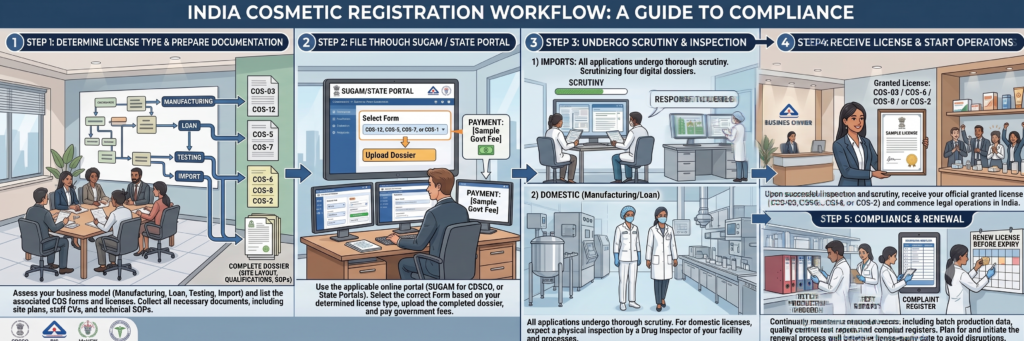
- Determine which license type — manufacturing, loan, testing, or import — matches your business model.
- Prepare the complete documentation package, including site layout, staff qualifications, and SOPs.
- File the relevant form (COS-12, COS-5, COS-7, or COS-1) through the applicable state portal or CDSCO’s SUGAM portal, along with government fees.
- Undergo scrutiny, and for domestic licenses, a physical premises inspection by a drug inspector.
- Receive the granted license (COS-03, COS-6, COS-8, or COS-2) and begin legal operations.
- Maintain batch records, test reports, and complaint registers, and renew the license before expiry.
Labeling, GMP, and Quality Compliance
Every licensed facility must comply with Schedule M-II’s Good Manufacturing Practice norms, covering hygiene, infrastructure, and record-keeping. Colourants must be selected from the approved list under Schedule Q, and labels must never carry therapeutic claims, which would reclassify a product as a drug. India also enforces a cruelty-free policy, prohibiting the import or sale of cosmetics tested on animals. For imported products specifically, labels must display the COS-2 registration number alongside standard details like batch number and manufacturing/expiry dates.
Why choose Regalliance?
Given the technical documentation and regulatory back-and-forth involved in registering cosmetics, most brands benefit from expert regulatory support. Regalliance assists businesses with product classification, dossier preparation, SUGAM portal filing, CDSCO query handling, label review, manufacturing licence support for domestic brands, and guidance on post-approval queries.
With end-to-end regulatory assistance, businesses can navigate the cosmetic registration process more efficiently while reducing documentation errors, regulatory delays, and unnecessary compliance challenges.
Comprehensive Cosmetic Regulatory Support
Regalliance supports brands throughout the cosmetic regulatory lifecycle, including product classification, technical dossier preparation, SUGAM portal submissions, CDSCO query responses, label compliance review, manufacturing licence support, and post-approval regulatory guidance.
Learn more about the team's experience and background on the About Regalliance page, or explore the complete range of Cosmetics Registration Services .
Conclusion
Whether you are a startup or an established global brand, completing Cosmetic Product Registration in India correctly helps protect your business legally and builds consumer trust in a fast-growing market. Getting the process right the first time can save months of delay and unnecessary costs while helping ensure a smoother regulatory journey.
Ready to Register Your Cosmetic Products?
Connect with Regalliance for expert regulatory guidance, documentation support, and complete cosmetic product registration solutions in India.
Contact RegalliancePhone: +91 9457775717
Email: info@regalliance.in