

AYUSH (Ayurveda, Siddha, & Unani) Regulatory Services
At Regalliance, we bridge the gap between traditional formulation ambition and intricate statutory compliance. We don’t merely fill out forms—we actively manage your regulatory risks so you can obtain your AYUSH licenses in record time and scale your commercial operations without port hold-ups, customs freezes, or portal bottlenecks.

Ayush Regulatory Services
At Regallience, we bridge the gap between traditional formulation ambition and intricate statutory compliance. We don’t merely fill out forms—we actively manage your regulatory risks so you can obtain your AYUSH licenses in record time and scale your commercial operations without port hold-ups, customs freezes, or portal bottlenecks.
Introduction
Ayurveda is fundamentally a science of life, offering a holistic approach to health and personalized medicine. As one of the world’s oldest medical systems, it encompasses thousands of intricate health concepts, therapeutic hypotheses, and time-tested formulations.
With global consumer preferences rapidly shifting toward natural health alternatives for both preventive and curative care, the Ayurvedic and herbal drug industry is witnessing unprecedented growth. However, this increased consumption brings stringent statutory scrutiny. Navigating diverse global standards, varying regional definition baselines for active ingredients, and highly technical validation requirements often creates unexpected regulatory roadblocks for manufacturers and brand owners.
Strategic Streams for ASU Drug Licensing
Under the provisions of the Drugs and Cosmetics Act, 1940, and the Drugs and Cosmetics Rules, 1945, Ayurvedic, Siddha, or Unani (ASU) drugs include all medicines intended for internal or external use in the diagnosis, treatment, mitigation, or prevention of diseases or disorders in human beings or animals.
To operationalize commercial distribution or manufacturing in India, brands must structurally align with one of the two core licensing pathways:
AYUSH Manufacturing Licensing Framework
Designed for businesses establishing independent manufacturing facilities for the production and sale of Ayurvedic, Siddha, and Unani (ASU) drugs within India.
Application Framework
Applications for grant or renewal are submitted in Form 24-D to the respective State Licensing Authority (SLA) along with the prescribed statutory fee of ₹1,000.
License Delivery
Upon compliance with the infrastructure, sanitation, and equipment requirements prescribed under Rule 157, the manufacturing licence is issued in Form 25-D.
Renewal Mechanism
Certificates for renewal of the manufacturing licence are granted through Form 26-D in accordance with applicable regulatory provisions.
Validity Period
The manufacturing licence remains valid for five (5) years from the date of issue unless suspended or cancelled by the competent authority.
Ideal for brand owners who market proprietary or classical ASU formulations by utilizing the manufacturing infrastructure of an existing GMP-compliant facility.
Application Framework
Loan licence applications are submitted using Form 25-E together with the prescribed statutory government fee of ₹600.
License Delivery
Permission to manufacture under a loan licensing arrangement is granted in Form 25-E under Rule 154-A.
Renewal Mechanism
Continued operations require renewal through the issuance of Form 26-E in accordance with the prescribed licensing process.
Validity & Compliance
Loan licences remain valid for five (5) years. License holders must maintain inspection records in Form 35 and provide access to authorized inspectors whenever required.
Technical Drug Categorization & Ingredient Mapping
To ensure absolute precision within your technical dossiers, our compliance team maps your product formulations into their exact statutory definitions:
Classification of ASU Drug Formulations
A. Classical / Shastriya / Traditional Formulations
These medicines are manufactured strictly in accordance with the exact formulations, ingredients, preparation methods, and standards described in the 103 authoritative books (including official pharmacopoeias and formularies) specified under the First Schedule of the Drugs and Cosmetics Act, 1940.
B. Patent or Proprietary Formulations
Patent or Proprietary ASU medicines are innovative formulations prepared exclusively from ingredients recognized in the authoritative Ayurvedic, Siddha, or Unani texts. These formulations must not be intended for parenteral (injectable) administration.
C. Permissible Ingredient Matrices
ASU formulations may comprise wholesome natural substances obtained from approved sources, provided they comply with the applicable quality and safety standards.
- Ingredients derived from plant, animal, mineral, or marine origins.
- Single-ingredient preparations including aqueous, hydro-alcoholic, and other recognized extracts.
- Complex poly-herbal and herbo-mineral formulations prepared in accordance with established ASU manufacturing principles.
The Statutory Architecture: Act & Rules at a Glance
Navigating AYUSH compliance requires deep structural knowledge of India’s dual legislative layers:
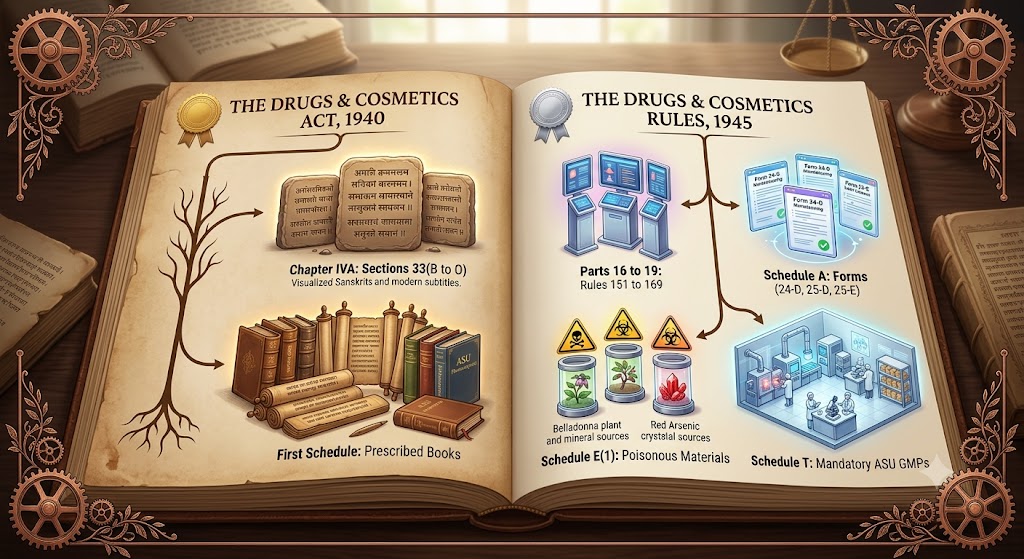
Schedule T Compliance: All manufacturing centers must meet the precise infrastructural, raw material testing, and hygiene benchmarks outlined in Schedule T (Good Manufacturing Practices) to pass mandatory state inspections.
Schedule E(1) Safeguards: Formulations incorporating any toxic or poisonous substances listed under Schedule E(1) must strictly conform to specialized labeling declarations and safe dosage thresholds.
Certifications for Global and Domestic Market Access
Beyond baseline state manufacturing licenses, scaling your brand requires third-party validation to build consumer trust and clear international trade barriers.
Quality Certifications & Export Compliance
A. WHO-GMP Compliance & Certificate of Pharmaceutical Product (CoPP)
Good Manufacturing Practices (GMP) establish the quality management framework that ensures medicinal products are consistently manufactured and controlled in accordance with prescribed quality standards and their intended use.
Manufacturers seeking international market access may obtain a Certificate of Pharmaceutical Product (CoPP) under the WHO Certification Scheme. The certificate is issued following a joint inspection involving the Central Drugs Standard Control Organization (CDSCO) and the respective State Licensing Authority to verify compliance with applicable GMP requirements.
B. AYUSH Mark Certification Scheme
The voluntary AYUSH Mark Certification Scheme is administered in coordination with the Quality Council of India (QCI). Certification is granted following independent third-party assessments conducted by accredited Certification Bodies (CBs) under the surveillance of the National Accreditation Board for Certification Bodies (NABCB).
AYUSH Standard Mark
Awarded to products that demonstrate full compliance with applicable Indian statutory quality requirements for AYUSH medicines, providing enhanced consumer confidence within the domestic market.
AYUSH Premium Mark
Granted to products complying with WHO-GMP requirements together with applicable destination-country regulations, supporting international acceptance and strengthening global market credibility.
End-to-End Execution Services Offered by Regallience
We act as your integrated regulatory department, combining scientific defense with agile portal execution to clear the following certification gates seamlessly:
State Licensing & Loan Agreements (Form 24-D / Form 25-E)
Official GMP Certificates (Rule 155B)
Free Sale & Market Standing Certificates
Non-Conviction & License Validity Certificates
Performance Evaluations & AYUSH Mark Approvals
Why choose Regalliance?
The AYUSH healthcare sector presents significant opportunities for Ayurvedic, Siddha, and Unani medicine manufacturers seeking domestic and international market access. However, successful commercialization requires precise compliance with manufacturing licensing requirements, quality standards, product classifications, and regulatory approval pathways.
Regulatory complexities including ASU drug licensing, GMP compliance, product category assessment, documentation requirements, and export certifications can impact product launch timelines. Regalliance provides end-to-end AYUSH regulatory services to help businesses navigate approvals efficiently while maintaining complete statutory compliance.
Comprehensive AYUSH Regulatory Services
Our experts support businesses with ASU manufacturing licence applications, loan licensing frameworks, product classification, GMP compliance, technical documentation, WHO-GMP and CoPP support, AYUSH Mark certification, and regulatory strategy for successful domestic and global market entry.
Accelerate Your AYUSH Market Entry
Connect with Regalliance for expert regulatory guidance, compliance support, and complete AYUSH product approval solutions.
Email: info@regalliance.in