Cosmetic Registration in India
Scale Your Cosmetic Brand in India with RegAllience
Launching a cosmetic business or expanding a global beauty brand into the Indian market presents significant growth opportunities. However, navigating the strict frameworks of the Drugs and Cosmetics Act, 1940, and the Cosmetics Rules, 2020, requires absolute precision. A single data mismatch on product labels or an unapproved formulation component can stall your commercial launch, leading to costly customs freezes and extended administrative delays.
At RegAllience, we clear the legal red tape for you. As your strategic regulatory partner, we offer end-to-end compliance tracking—from meticulous formulation reviews and site layout planning to seamless portal submissions—ensuring your products hit the market securely and right on schedule.
Cosmetic Registration in India
Launching a cosmetic business or expanding a global beauty brand into the Indian market presents significant growth opportunities. However, navigating the strict frameworks of the Drugs and Cosmetics Act, 1940, and the Cosmetics Rules, 2020, requires absolute precision.
At RegAllience, we clear the legal red tape for you. As your strategic regulatory partner, we offer end-to-end compliance tracking—from meticulous formulation reviews and site layout planning to seamless portal submissions—ensuring your products hit the market securely and right on schedule.
How to Get Cosmetic Registration in India?
The cosmetic market in India is expanding exponentially. From traditional television advertisements to high-growth social media platforms, thousands of brands are scaling rapidly in a sector that has proven historically resilient to economic recessions. Today, the demand for beauty and personal care products spans all demographics, reflecting a massive shift toward regular skincare, grooming, and aesthetic wellness across both male and female consumer segments.
However, with market expansion comes strict regulatory accountability. Due to the high potential for product misrepresentation and safety fraud, the industry is closely scrutinized by government bodies. In India, all cosmetic operations are strictly governed by the Drugs and Cosmetics Act, 1940, and the Cosmetics Rules, 2020.
The Legal Definition of a "Cosmetic"
Under Section 3(aaa) of the Drugs and Cosmetics Act, a cosmetic is officially defined as:
“Any article intended to be rubbed, poured, sprinkled, or sprayed on, or introduced into, or otherwise applied to, the human body or any part thereof for cleansing, beautifying, promoting attractiveness, or altering the appearance, and includes any article intended for use as a component of cosmetic.”
Any product entering the Indian market—whether local or imported—must match this legal definition perfectly. If a product brand goes beyond aesthetic enhancement and claims to treat or cure a medical condition (such as chronic acne or hair loss), the Central Drugs Standard Control Organization (CDSCO) will reclassify it as a “Drug,” subjecting it to much more rigorous clinical licensing protocols.
Navigating these regulatory boundaries requires absolute precision. At Regallience, we clear the legal red tape for you. We meticulously screen your formulations, manage complex filings, and ensure your labels and ingredients align completely with Indian compliance standards so your brand can launch without administrative delays or customs rejections.
Types of Cosmetic Registration in India
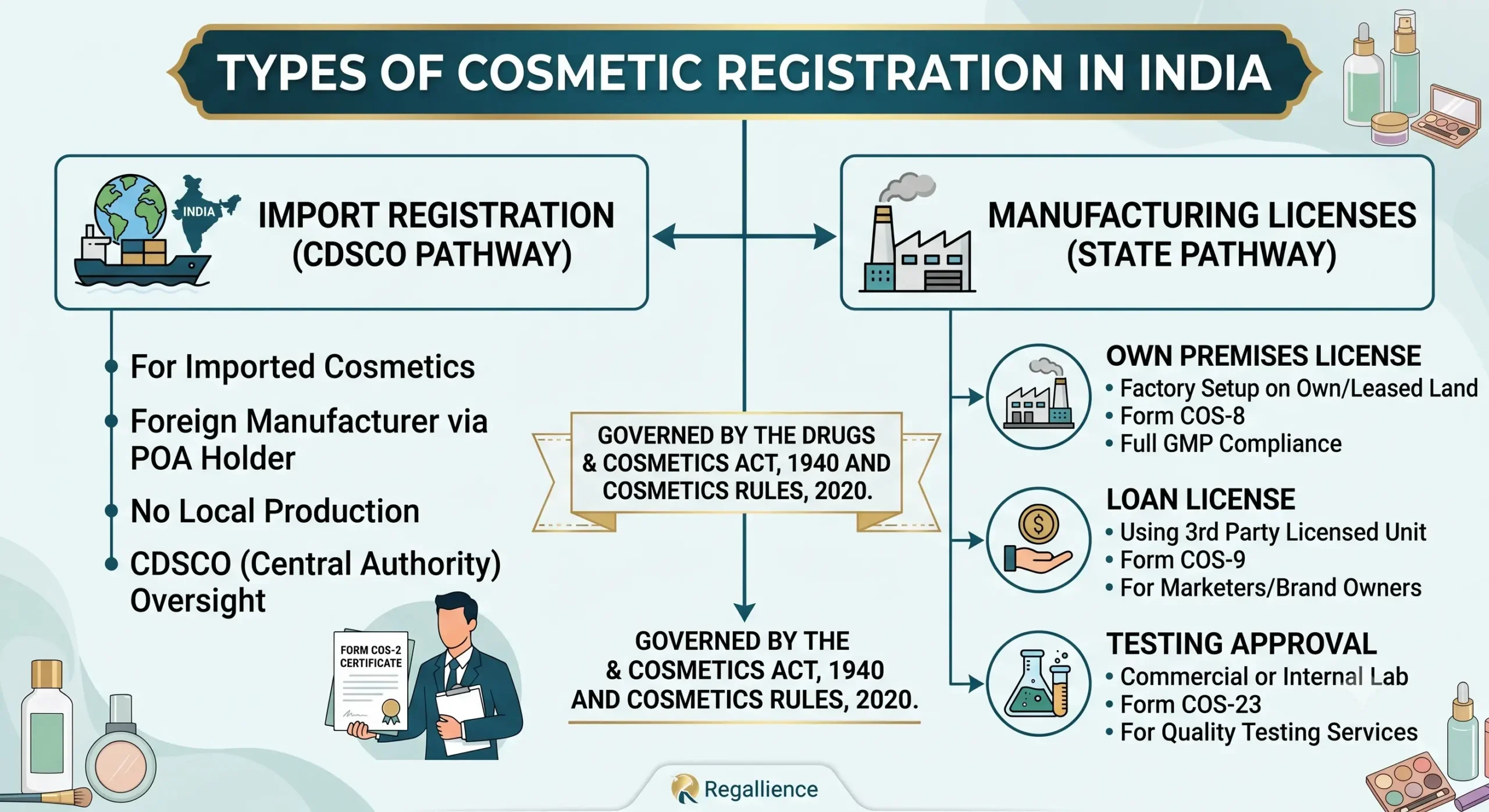
1. Import Registration
An Import License is mandatory when an entity does not manufacture the cosmetics locally but imports and resells them in the Indian market. Foreign manufacturers cannot apply directly; they must execute a Power of Attorney (POA) to appoint a localized entity.
- Eligible Applicants: A manufacturer with a registered office in India, an authorized agent, a subsidiary of the manufacturer, or any other certified importer.
- Application Pathway: Importers must file an application to map out product categories, brands, and variants to the Central Licensing Authority (CDSCO).
Legal Framework for Imports
Application Form: Form COS-1 (formerly Form 42).
Issued Certificate: Form COS-2 (formerly Form 43).
- Statutory Fees: A base fee structure applies per cosmetic category, manufacturing site, and product variant.
- Validity: The official Import Registration Certificate remains valid for a designated 5-year period under current rules, provided structural retention steps are met.
2. Domestic Manufacturing Licenses
When an entity intends to produce cosmetics locally within India, the workflow transitions to the respective State Licensing Authority (SLA). Depending on your infrastructure and asset model, you must apply for one of three distinct manufacturing streams:
- Own Premises License: Applicants must submit Form COS-5. Upon approval, the license is issued in Form COS-8. The license is regulated by the State Licensing Authority (SLA) and remains valid for 5 years.
- Loan License: Applicants must submit Form COS-6. Upon approval, the license is issued in Form COS-9. The license is regulated by the State Licensing Authority (SLA) and remains valid for 5 years.
- Testing Approval: Applicants must submit Form COS-22. Upon approval, the approval certificate is issued in Form COS-23. The approval is regulated by the State Licensing Authority (SLA) and remains valid for 5 years.
When an entity intends to produce cosmetics locally within India, the workflow transitions to the respective State Licensing Authority (SLA). Depending on your infrastructure and asset model, you must apply for one of three distinct manufacturing streams:
| License Category | Application Form | Issued Certificate | Regulatory Oversight | Validity |
| Own Premises | Form COS-5 | Form COS-8 | State Licensing Authority (SLA) | 5 Years |
| Loan License | Form COS-6 | Form COS-9 | State Licensing Authority (SLA) | 5 Years |
| Testing Approval | Form COS-22 | Form COS-23 | State Licensing Authority (SLA) | 5 Years |
Cosmetic Regulations in India for Cosmetic license
Under the Drugs and Cosmetics Rules, cosmetics are classified into 11 categories under Schedule M-II. Any company intending to manufacture cosmetics within these categories must obtain a manufacturing license from the respective State Licensing Authority (SLA).
The application for a cosmetic manufacturing license must be submitted in Form COS-5, accompanied by a statutory license fee of ₹2,500 and an inspection fee of ₹1,000 for each site inspection.
The categories covered under Schedule M-II include:
Powders, including talcum powder and face powder.
Creams, lotions, cleansing milk, shampoos, pomades, shaving creams, hair oils, and similar products.
Nail polishes and nail lacquers.
Lipsticks and lip glosses.
Depilatories, including hair removal creams and waxes.
Preparations used for the eyes, such as eyeliners, kajal, and mascara.
Aerosol products, including deodorants and other spray-based cosmetics.
Alcoholic fragrance solutions, such as perfumes and colognes.
Hair dyes and colorants.
Tooth powder and toothpaste.
Toilet soaps.
For all the above categories, the prescribed application form is Form COS-5, and the licensing authority is the respective State Licensing Authority (SLA).
Under the Drugs and Cosmetics Rules, cosmetics are systematically classified into 11 broad product categories under Schedule M-II. To manufacture or distribute any product within these categories locally, companies must obtain a manufacturing license from their respective State Licensing Authority (SLA).
An application must be submitted via Form COS-5 (formerly Form 31) along with a statutory license fee of ₹2,500 and an inspection fee of ₹1,000 per site audit.
Schedule M-II: Cosmetic Categories & Regulatory Mapping
| Category No. | Cosmetic Product Classification | Statutory Application Form | Primary Licensing Authority |
| 1 | Powders (Talcum, Face Powders, etc.) | Form COS-5 | State Licensing Authority (SLA) |
| 2 | Creams, Lotions, Cleansing Milk, Shampoos, Pomade, Shaving Creams, Hair Oils, etc. | Form COS-5 | State Licensing Authority (SLA) |
| 3 | Nail Polishes and Nail Lacquers | Form COS-5 | State Licensing Authority (SLA) |
| 4 | Lipsticks and Lip Gloss | Form COS-5 | State Licensing Authority (SLA) |
| 5 | Depilatories (Hair Removal Creams/Waxes) | Form COS-5 | State Licensing Authority (SLA) |
| 6 | Preparations Used for Eyes (Eyeliners, Kajal, Mascara, etc.) | Form COS-5 | State Licensing Authority (SLA) |
| 7 | Aerosols (Deodorants and Spray Products) | Form COS-5 | State Licensing Authority (SLA) |
| 8 | Alcoholic Fragrance Solutions (Perfumes, Colognes, etc.) | Form COS-5 | State Licensing Authority (SLA) |
| 9 | Hair Dyes and Colorants | Form COS-5 | State Licensing Authority (SLA) |
| 10 | Tooth Powder and Toothpaste | Form COS-5 | State Licensing Authority (SLA) |
| 11 | Toilet Soaps | Form COS-5 | State Licensing Authority (SLA) |
Mandatory Compliance & On-Site Verification
Securing a license requires strict adherence to two operational pillars:
1. Technical Staff Competency Benchmarks
Production must take place under the direct, full-time supervision of qualified technical personnel. At least one staff member must fulfill any of the following credentials:
Holds a Diploma in Pharmacy approved by the Pharmacy Council of India (PCI) under the Pharmacy Act, 1948, OR
Is officially registered under the Pharmacy Act, 1948, OR
Has passed an intermediate examination with Chemistry as a core subject, or an equivalent academic qualification recognized by the licensing authority.
2. Pre-Grant Site Inspection
Before a license is granted or denied, a designated State Drug Inspector will conduct a comprehensive audit of the proposed premises. The inspector evaluates the plant layout, sanitation standards, and machinery. A formal inspection report is then submitted to the Licensing Authority, which serves as the deciding factor for the issuance of your official Form COS-8 manufacturing license.
Accelerate Your Compliance Layout with Regallience
A single error in ingredient classification or an unmapped variant under Schedule M-II can cause your application to be rejected, stalling your production timeline by months. At Regallience, we proactively manage your entire domestic portfolio setup. We audit your plant design for Good Manufacturing Practices (GMP) readiness , pre-screen your technical personnel dossiers, and ensure your state-level filings are flawless for a successful inspection.
Mandatory Product Labeling Regulations for Manufacturers
Under the Drugs and Cosmetics Rules, maintaining absolute accuracy in your packaging architecture is critical to avoiding product rejections or regulatory penalties. The Central Drugs Standard Control Organization (CDSCO) and state authorities mandate that all physical retail packaging strictly adhere to the following layout frameworks:
- Product & Manufacturer Layout: The exact name of the product must be clearly displayed on both the inner and outer labels. For small-sized containers where surface area is limited, explicitly printing the principal place of manufacture along with the correct pin code satisfies compliance parameters.
- Ingredient Transparency: The outer label must provide a comprehensive, transparent list of all ingredients utilized during production.
- Safety & Usage Protocols: The inner label must feature clear, legible directions for use, alongside any necessary hazard warnings, allergen alerts, or safety precautions.
- Statutory Identification Codes: To ensure clear traceability, the packaging must explicitly state a distinct batch number preceded by the letter “B” and the official manufacturing license number preceded by the letter “M”.
- BIS Quality Standardization: Beyond the base Act, the quality, raw material safety thresholds, and structural layouts must concurrently comply with the updated standards set by the Bureau of Indian Standards (BIS), which routinely checks and revises personal care benchmarks.
Eliminate Packaging Vulnerabilities with Regallience
Labeling non-compliance is one of the leading causes of product hold-ups and customs rejections in the Indian market. Even a minor typographical variance between your official registration certificates and your retail text can stall your entire distribution pipeline.
At Regallience, we provide comprehensive artwork and labeling validation. Our regulatory specialists perform complete micro-checks—cross-aligning font sizes, claim boundaries, and formatting characters across your entire dossier—to ensure your products achieve flawless market entry.
Unified Statutory Dossier Checklist for Cosmetic Registration in India
To navigate the Central Drugs Standard Control Organization (CDSCO) and State Licensing Authority (SLA) verification processes without severe administrative delays or customs hold-ups, your application must be accompanied by an airtight technical dossier. Discrepancies between physical blueprints, corporate addresses, or certificate spellings will stall your market entry timeline.
Below is the definitive document inventory required for both distribution pathways:
1. Technical Dossier Checklist for Import Registration (Form COS-1 / COS-2)
Foreign cosmetic brands cannot submit applications directly to the government gateway and must operate through an authorized localized entity.
1.Authorized Legal Representation:
Power of Attorney (POA): The original, legally binding Power of Attorney executed by the foreign manufacturer, establishing an airtight legal bridge with the local importer. The POA must be officially apostilled or legalized.
Eligible Applicants: The submission must be anchored by an authorized agent of the manufacturer, a subsidiary of the manufacturer, a manufacturer with a registered office in India, or any other certified importer.
2. Global Market Authentications:
Free Sale Certificate (FSC): An official Free Sale Certificate, valid manufacturing license, or marketing authorization letter issued by the national regulatory body of the country of origin.
Form COS-1 Application File: The validated, system-generated application form detailing product brands, categories, and manufacturing site matrices.
3. Formulation & Packaging Validation:
Ingredient Declaration: A comprehensive composition formula displaying exact ingredient names and percentages, cross-verified against Bureau of Indian Standards (BIS) constraints.
Artwork & Label Proofs: High-resolution color copies of the inner and outer retail packaging. Labels must feature specific space allocations for future registration details, batch codes, and formatting styles that match the Cosmetics Rules, 2020.
Testing Protocols: Documented product specifications and explicit laboratory testing methods.
Mandatory Declarations: A signed Non-Animal Testing Undertaking confirming the final product has not undergone animal testing.
2. Statutory Dossier Checklist for Domestic Manufacturing Licenses
Local production operations fall under the direct jurisdiction of the State Licensing Authority (SLA). To secure an operational manufacturing license, units must assemble the following master compliance file:
1. Premises & Legal Framework:
Proof of Physical Possession: A fully executed rental agreement (in the case of leased premises) or a registered ownership deed for the facility.
Industrial Blueprints: An architect-certified layout plan and blueprint mapping out the key plan and manufacturing plant specifications.
Environmental Clearance: An official No Objection Certificate (NOC) issued by the relevant State Pollution Control Board.
Entity Constitution Proof: Certified copies of the firm’s registration, partnership deed, or MOA/AOA showing the formal structure of the company.
2. Plant Machinery & Operations:
Installed Machinery Register: A comprehensive technical inventory itemizing all processing and packaging machines installed on the floor.
Quality Control Setup: A detailed list of laboratory equipment used for analytical testing, or a Memorandum of Understanding (MoU) with an accredited testing partner.
3. Personnel & Technical Qualifications:
Competent Technical Staff Allocation: Comprehensive bio-data forms, appointment records, and signed employment contracts for full-time technical supervisors.
Educational Credentials: Certified copies of degrees or diplomas (e.g., in Pharmacy or Cosmetic Technology) along with original registration certificates from the Pharmacy Council of India.
4. Legal Declarations:
Affidavit of Applicant: A notarized affidavit of non-conviction for the firm’s partners, proprietors, or directors under the Drugs and Cosmetics Act.
Secure Your Supply Chain with Regallience
Missing a single field on a foreign manufacturer’s certificate or displaying a minor typo on your label artwork can trigger a formal discrepancy query on the SUGAM portal, resetting your timeline by 3 to 6 months. At Regallience, we perform proactive, multi-tier document screening. We cross-verify your technical parameters, align your packaging layouts with BIS standards, and guide your file through the government review gates to ensure a predictable and successful launch.
Why Choose Regalliance?
At Regalliance, we have built a reputation as India’s finest regulatory firm by delivering premium compliance structuring and cosmetic registration at a highly optimized, business-friendly price point. We don’t just fill out forms—we actively manage your regulatory risks.
Our specialized technical support includes complete Labeling Artwork Validation to align text formatting and ingredient listings with strict Bureau of Indian Standards (BIS) parameters. Furthermore, we provide Certified Sample Testing Coordination, routing your product batches through accredited, CDSCO-approved, and NABL-certified laboratories to smoothly clear heavy metal, chemical, and microbiological thresholds.
Ready to streamline your Indian market entry? Email us: info@regalliance.in
Frequently Asked Questions (FAQs)
Who is eligible to apply for a Cosmetic Import Registration Certificate in India?
Foreign cosmetic manufacturers are restricted from submitting applications directly onto the government portal. Instead, the legal process dictates that the application must be managed and anchored by a localized legal gateway entity operating within India. This authorized Indian applicant can be an agent or representative appointed through an official Power of Attorney (POA), a registered local subsidiary of the foreign firm, a manufacturer with registered domestic premises, or any other certified local importer.
What is the core difference between an "Own Premises License" and a "Loan License" for domestic manufacturing?
The choice between these two structural pathways depends entirely on your business asset model and physical infrastructure footprint. An Own Premises License (Form COS-8) is mandatory for brands that establish, own, or directly lease a physical factory footprint where they handle layout setups, satisfy Good Manufacturing Practices (GMP), and host state inspections. Conversely, a Loan License (Form COS-9) is specifically designed for startups, marketers, and brand owners who do not own factory infrastructure but wish to legally manufacture their formulations using a third-party licensed facility, eliminating heavy capital expenditures on machinery.
What are the statutory government fees required for importing cosmetics into India?
The Central Drugs Standard Control Organization (CDSCO) manages fee collections online through the integrated portal. Under current rules, the official statutory fee structure requires payment of USD 1,000 per cosmetic category, USD 500 per manufacturing site, and an additional USD 50 for each specific product variant or SKU introduced to the market.
How long does the cosmetic registration process typically take, and what is its validity?
The standard regulatory workflow from submission to final approval typically spans between 3 to 6 months. This turnaround time is highly dependent on technical document clarity and the speed with which a brand resolves portal queries. Once successfully granted, both Import Registration Certificates (Form COS-2) and domestic manufacturing licenses remain legally valid for a designated 5-year period, provided structural retention fees are maintained.
When should I initiate the renewal process for my cosmetic license to avoid penalties?
To maintain a completely uninterrupted supply chain and prevent costly customs rejections or port freezes, renewals must be filed 6 months prior to the 5-year expiration window. This proactive window ensures the CDSCO or state authorities have sufficient time to process your structural retention data without resetting your commercial market timeline.
What qualifications must the technical staff possess to obtain a domestic manufacturing license?
To successfully clear the State Licensing Authority (SLA) technical review, local cosmetic production must take place under the direct, full-time supervision of competent technical personnel. The supervisor in charge must satisfy specific educational benchmarks, such as holding an approved Diploma in Pharmacy under the Pharmacy Act, 1948, being a registered pharmacist, or having passed an intermediate examination with Chemistry as a core subject alongside a recognized degree in Cosmetic Technology.
What are the critical packaging and labeling details mandated by the CDSCO and BIS?
Labeling compliance is heavily scrutinized, meaning all retail packaging must explicitly show the product name on both the inner and outer labels. Additionally, the outer label must feature a transparent ingredient list, while the inner label must detail clear directions for use along with relevant hazard warnings. The design must also explicitly state a distinct batch number preceded by the letter "B", the manufacturing license number preceded by the letter "M", and maintain an absolute cross-alignment of all manufacturer addresses across the POA, Free Sale Certificate (FSC), and physical boxes to eliminate clerical delays.
Does my cosmetic product require local laboratory sample testing?
To satisfy the safety thresholds mandated by the Bureau of Indian Standards (BIS), your product formulations must successfully clear comprehensive safety testing. This means sample batches must be systematically routed through certified, CDSCO-approved, and NABL-accredited laboratories across India to run chemical analyses and heavy metal checks before hitting retail shelves.